




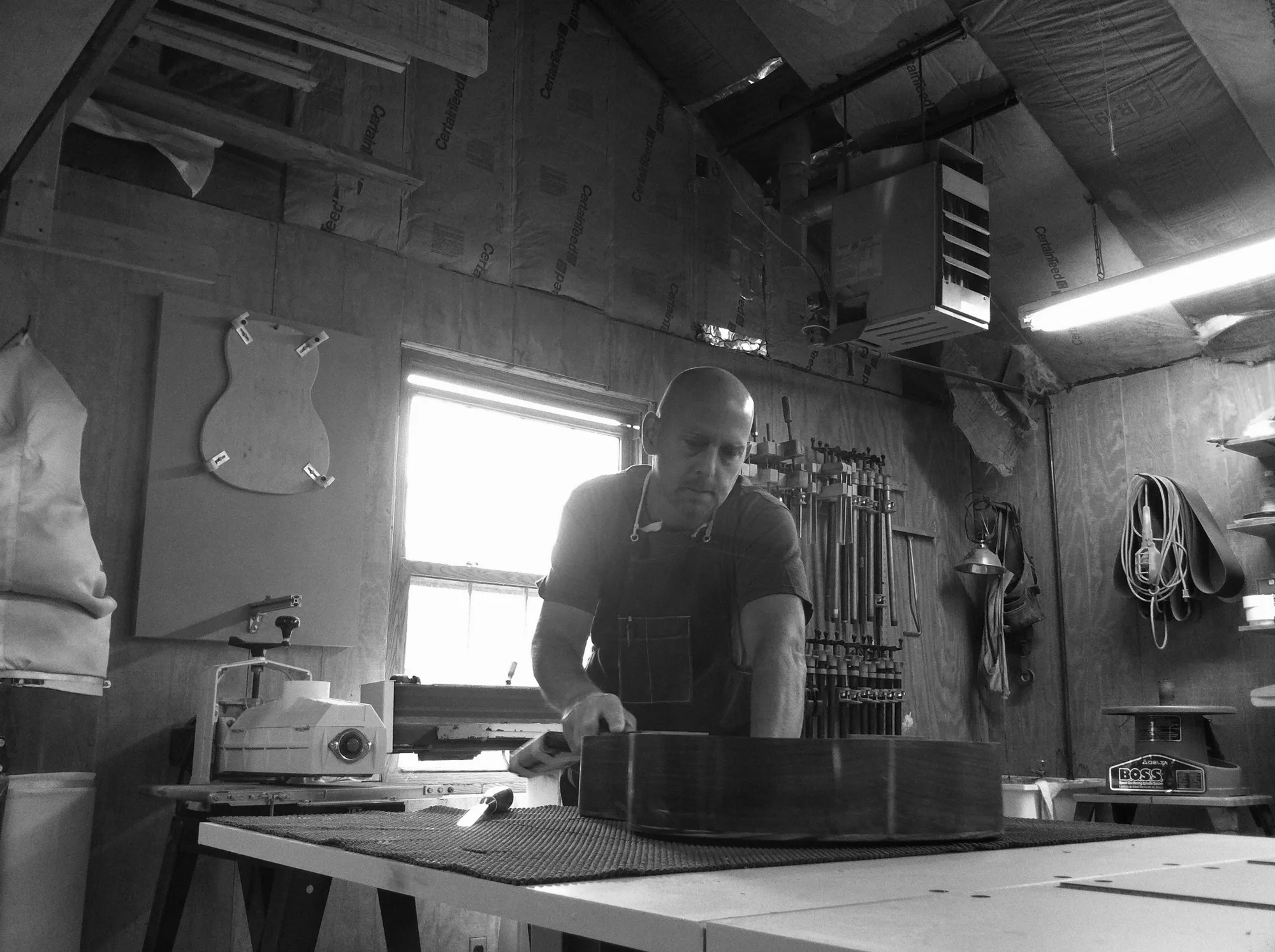
Some of my story
A guitar is an outwardly simple device. Its beauty and soul are in the materials and the attention the builder gives to nuance and detail.
I found the guitar at thirteen, when a neighbor started taking lessons. For the next ten years I could not get enough. Some weeks I studied with two or three teachers at once. I performed locally and regionally, gave private lessons, and practiced for hours every day. Out of necessity I taught myself to repair, build, and maintain my own instruments.
I grew up among generations of woodworkers and craftsmen, and I carried that on. What started as a couple of shelves in the basement became a fully equipped woodshop. Over time my interest moved from performing on the instrument to making it. After more than 25 years the passion continues.
Today I build handcrafted classical guitars for the discerning enthusiast. I use the finest materials I can find and traditional construction techniques. My guitars are built to give their owners years of enjoyment, with a simplicity and quality that my great-great-grandfather would approve of.

U.S. Patent 1,446,758 · February 27, 1923
My great-great-grandfather gave the guitar its backbone.
Thaddeus J. McHugh ran the Gibson factory floor in Kalamazoo, and sang Irish tenor with Orville Gibson before there was a company at all. In 1923 he patented the adjustable truss rod. Almost every steel-string guitar made since carries one.
Read his storyMy work
Built one at a time, after Hermann Hauser.
When you order one of my guitars, I encourage you to be involved in every part of the build: the first conversation, the features that suit how you play, the woods, the finish. To me that is what makes a guitar custom. Every part of it starts from what you need.
I build only a limited number of guitars each year, from a player’s perspective, with mostly traditional methods. With the master luthiers that came before us, I could not convince myself to do it any other way.
The standard build
- Top
- Engelmann spruce or western red cedar, finest grade
- Back and sides
- East Indian rosewood
- Neck
- Spanish cedar, Spanish heel construction
- Fingerboard
- Rosewood
- Bridge
- Rosewood, bone tie block inlay
- Bindings
- All wood
- Rosette
- Natural wood
- Scale
- 650 mm
- Width
- 52 mm at the nut, 64 mm at the 12th fret
- Nut and saddle
- Natural bone
- Finish
- Multistage varnish, hand buffed
- Tuners
- Gotoh Premium or Gilbert
- Case
- SKB thin-line hardshell, humidifier, digital hygrometer
Other scales and string spacing can be accommodated. The neck can be shaped to your preference.
Options, à la carte
Prices vary with availability and current market value.
Back and sides
- African blackwood
- Amazon rosewood
- Bocote
- Bubinga
- Black walnut
- Claro walnut
- Cocobolo
- Honduran rosewood
- Indian rosewood (standard)
- Indonesian rosewood
- Koa
- Macassar ebony
- Pau ferro
- Sapele
- Tasmanian blackwood
- Wenge
- Zebrawood
- Ziricote
Tops
- European spruce
- Engelmann spruce (standard)
- Western red cedar (standard)
- Reclaimed western red cedar, streaked
Thermal curing (torrefaction) is available on all tops. It ages the wood in a controlled way, so the top is stiffer, lighter, and a golden brown.
Tuning machines
- Alessi
- Fustero
- Gilbert (standard)
- Gotoh Premium (standard)
- Graf
- Irving Sloane
- Schaller
- Waverly
Finish
- Varnish (standard)
- Shellac, sprayed
- Shellac, French polished
- Nitrocellulose
- Nitrocellulose body with French polished top
Neck, fingerboard, and bridge
- Carbon fiber neck stiffener
- Ebony or rosewood (standard)
- Custom widths
- Custom scale (650 mm standard)
- Radiused fingerboard
- Twelve-hole tie block
Policies
Ordering
I build a limited number of guitars each year. When you order, I ask for a deposit of thirty-five percent of the total price, and the balance on completion.
You are welcome to inspect the guitar during construction, by appointment. All transactions must be in U.S. funds or equivalent: cash, money order, or certified bank draft. Meeting CITES or any other export and import rules is the responsibility of the owner.
Warranty
I warrant my instruments against defects in materials and workmanship for my life as an active luthier. The warranty does not cover fair wear and tear, abuse, neglect, or extremes of temperature or humidity. Despite years of proper seasoning, some wood species tend to develop hairline fractures.
Periodic maintenance is the responsibility of the owner and is a condition of this warranty. Care accessories and instructions come with each instrument. Repairs or alterations by anyone else may cancel the warranty. Transportation costs are the responsibility of the owner.
Returns
If an instrument proves unsuited to the player, it can be returned within fifteen days of receipt for the purchase price, minus shipping and handling. If it is not in new condition, the cost of restoration is also deducted. I send the refund as soon as I have inspected the returned instrument.
Gallery
Some of my guitars.
Let’s talk
How can I help?
Ask me about a new guitar, the woods, the options, or anything else on this page. I work by appointment only.