
Kalamazoo, Michigan · 1859 – 1945
Thaddeus J. McHugh
My great-great-grandfather never played the guitar. He sang. But a steel rod he put inside a guitar neck in 1921 is inside almost every steel-string guitar made since.
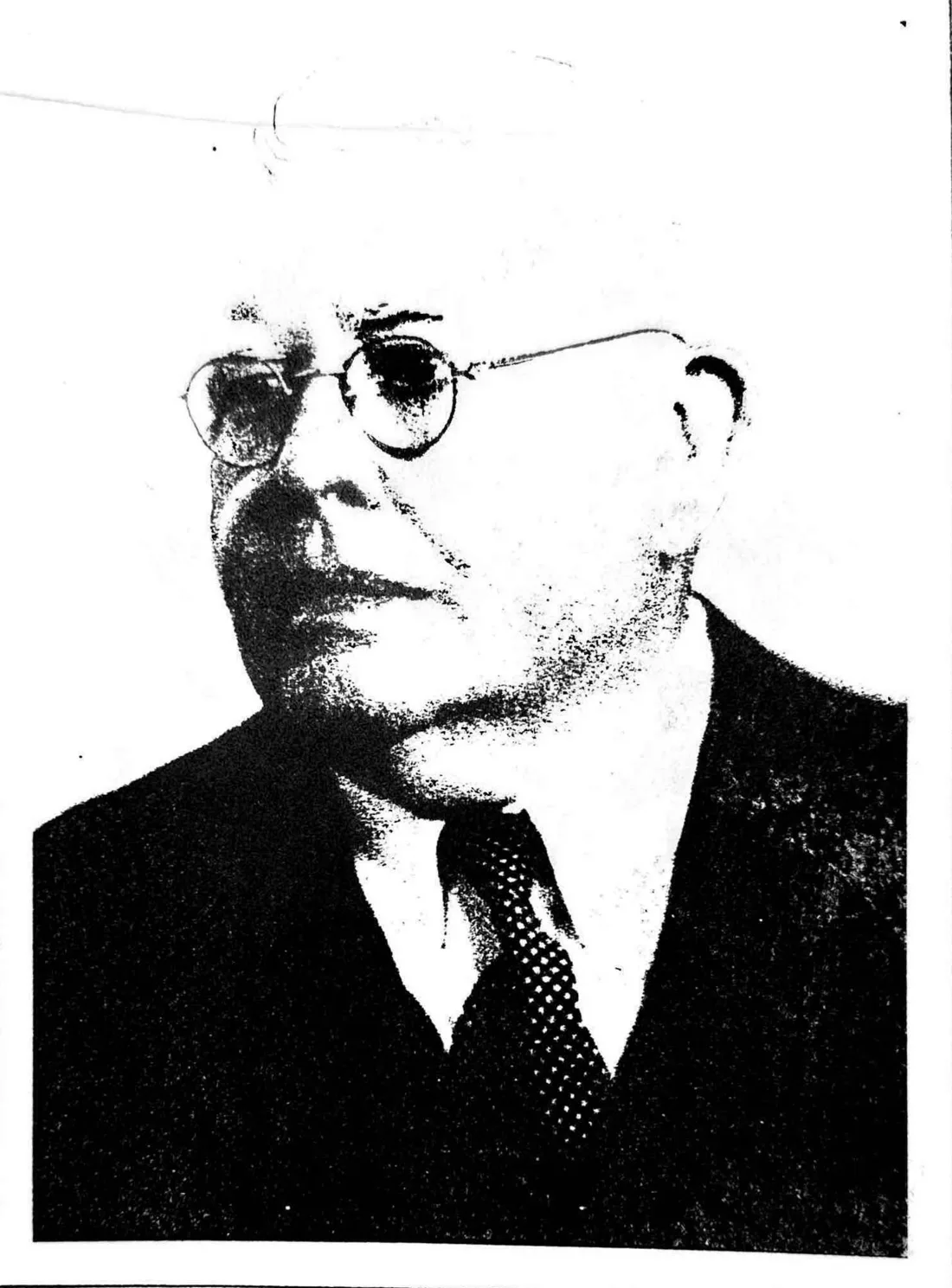
The singer
He knew Orville Gibson from the stage, not the shop.
Thaddeus was born on St. Patrick’s Day, 1859, on the Kalamazoo land his father had traded a team of oxen for. Patrick McHugh had come from County Cavan and cleared the railroad right-of-way into town. His son went to work in a handle factory at fourteen and stayed a woodworker all his life.
What the town knew him for was his voice. Around age twenty he sang at a Fire Department benefit, then studied for three years with a local professor. He sang first tenor in a male quartet and in the choir at St. Augustine. At a benefit in the early 1880s he appeared with a young guitarist named Orville Gibson. The two became friends and performed together. His granddaughter wrote in 1941 that he had been “in public light as a singer of Irish songs” for fifty years, and that at past eighty he could still sing very well.

The truss rod
Steel strings were bending guitar necks. He put the answer inside the neck.
In 1907 Thaddeus joined the young Gibson Mandolin-Guitar Company as foreman of the woodworking shop. He became factory superintendent, and by the 1920s he had an office at the factory for experimental work, design, and drafting.
The problem of the day was steel. Gut strings pull gently, and a plain wooden neck can hold them. Steel strings pull much harder, and necks bowed forward under the load. Builders answered with very thick necks that were hard to play.
His answer was a steel rod set in a curved channel under the fingerboard, anchored in the heel, with a nut at the headstock. Tighten the nut and the rod pushes the middle of the neck back. A neck could now be slim, and if it moved with the seasons, the player could correct it in a minute.
“By this arrangement of parts, I am also enabled to use wood which has not been heretofore considered satisfactory for the manufacture of necks.”
Gibson still builds with it. Over the following decades the rest of the industry adopted adjustable rods too. The slim, fast necks that modern players take for granted start here.
Two more patents
A bridge the player could set, and a banjo.
Two years before the truss rod, he and Lewis A. Williams patented a bridge that rides on two threaded posts. Turn the threaded rests and the strings rise or fall. The patent calls it a bridge “which may be adjusted to best serve the requirements of the instrument on which it is used or the player.” One of the two witnesses who signed it was Lloyd Loar, the acoustic engineer behind Gibson’s F-5 mandolin.
A third patent, with D. C. Mafit in 1922, covers a banjo. His grandson Jack remembered a quieter product of the same hands: a labelled set of sample blocks, one for each wood Gibson used, made for a curious boy.

A life in Kalamazoo
From a cleared right-of-way to a workshop barn.
- 1838Patrick McHugh leaves County Cavan, Ireland, and comes to North America by way of Maidstone, Ontario.
- 1844Patrick clears the Michigan Central Railroad right-of-way into Kalamazoo, trades his oxen for land on West North Street, and stays.
- 1859Thaddeus Joseph McHugh is born on that land on March 17, St. Patrick's Day.
- 1873At fourteen he goes to work in wood, at the Forbes Handle Factory.
- 1880sHe studies voice for three years. He sings first tenor in a quartet, and at a benefit he shares the bill with a local guitarist, Orville Gibson. They become friends and musical partners.
- 1885He marries Alice Susannah Wood of Marshall, Michigan. They build a house at 216 West North Street and raise nine children there.
- 1899He runs his own furniture firm, Everett, McHugh & Co.
- 1907He joins the Gibson Mandolin-Guitar Company as foreman of the woodworking shop. He later serves as factory superintendent.
- 1921Patent 1,365,839, with Lewis A. Williams: a bridge the player can raise and lower. Lloyd Loar signs as a witness.
- 1922Patent 1,402,876, with D. C. Mafit: a banjo.
- 1923Patent 1,446,758: a neck with an adjustable steel rod inside it. The truss rod.
- 1941Past his 82nd birthday, he is still at the factory, now in the stockroom.
- 1945He dies on June 21, aged 86. Alice, his wife of sixty years, follows five weeks later.
- 1996His great-great-grandson starts TSH Guitars.
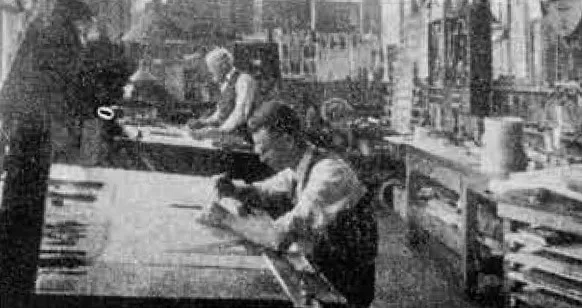
The family line
Five generations, from a Gibson drafting table to a guitar bench.
Thaddeus Joseph McHugh
1859 – 1945 · Woodworker, Gibson foreman and designer, Irish tenor
Ethelind Alice McHugh Harvey
1894 – 1949 · His daughter. Married Olin Esty Harvey, a tool designer, in 1915
Thomas Hugh Harvey
born 1918 · Her son. His brother Jack kept the family records
Thomas Swan Harvey
His son
Thomas S. Harvey
His son. Builds classical guitars as TSH Guitars
Why it matters at my bench
What he passed down was not a part. It was a standard.
A classical guitar is strung with nylon, which pulls far more gently than steel, so my necks need no truss rod. A carbon fiber stiffener is there for players who want one. The standard I took from Thaddeus is the one behind his patents: an instrument should fit its player, keep doing so for decades, and be simple to put right when the wood moves.
That standard came down through generations of woodworkers and guitar players in my family. I build every guitar hoping he would approve of it.
See the guitarsSources
- U.S. Patent 1,446,758, Neck for Musical Instruments. Filed April 5, 1921; granted February 27, 1923.
- U.S. Patent 1,365,839, Bridge for Stringed Musical Instruments. Filed May 28, 1920; granted January 18, 1921.
- U.S. Patent 1,402,876, Banjo. Granted January 10, 1922.
- Robert Eugene Meader, biography of Thaddeus and Alice McHugh, Kalamazoo Public Library Historical Directory typescript, May 1940.
- John O. “Jack” Harvey, “Grandpa McHugh,” family memoir, July 27, 1994, and family charts, 1984–85.
- Patricia Harvey, school essays on her family, 1941.
- Walter Carter, Gibson Guitars: 100 Years of an American Icon (1994), and letters to Jack Harvey, 1993–94.